
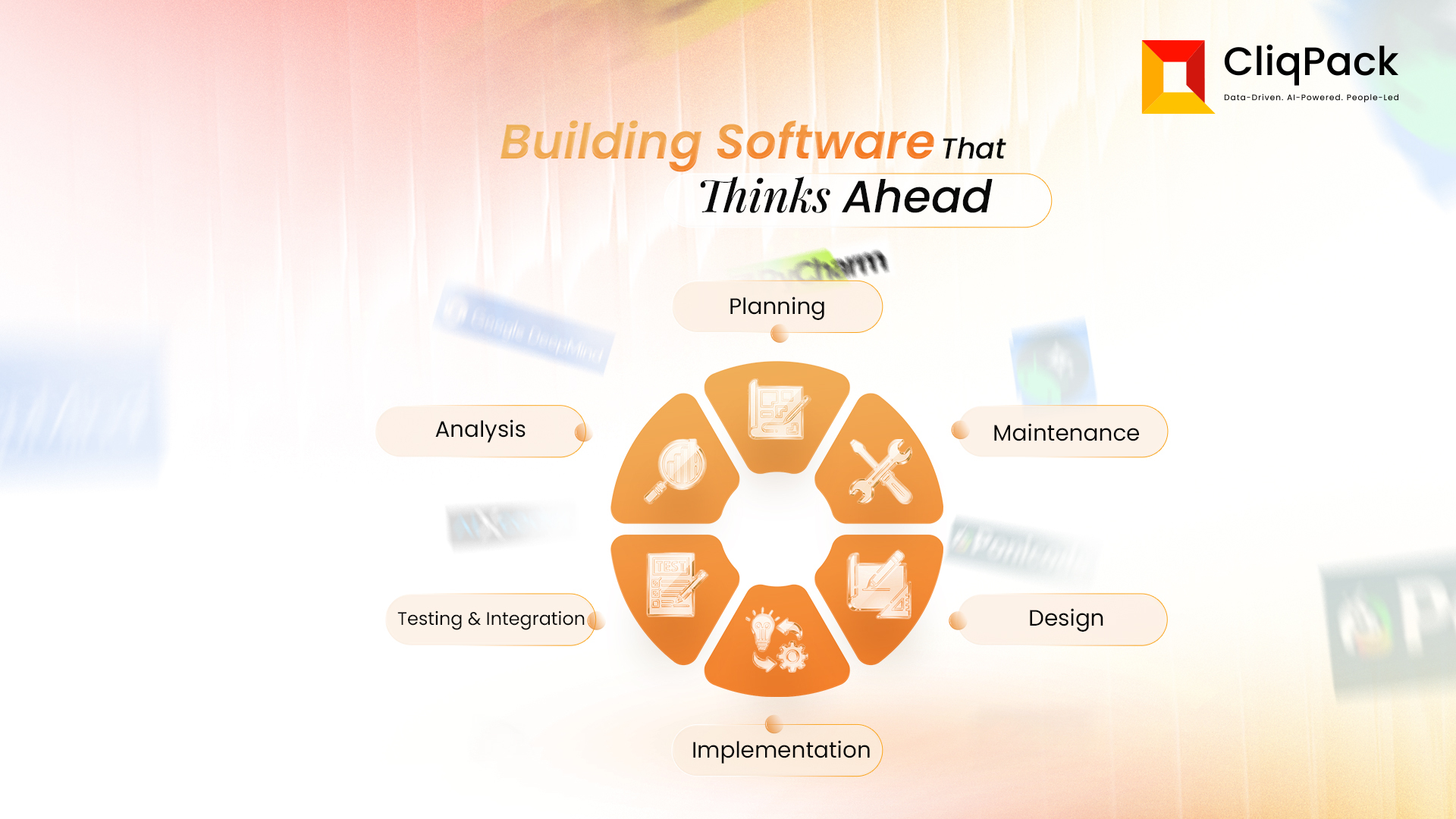
In the software industry, every few decades mark a structural shift that redefines how technology is built and scaled. The waterfall model gave rise to Agile, Agile gave birth to DevOps, and now the foundation is shifting again, this time towards intelligence-driven automation. Artificial Intelligence is not entering the Software Development Life Cycle (SDLC) as a convenience tool; it is gradually redefining the very philosophy behind how we plan, build, and deliver software.
For years, development teams have relied on structured phases: ideation, design, coding, testing, and deployment. Agile and DevOps optimized the speed and collaboration within these phases but kept the linear logic intact. AI, however, is dissolving those boundaries entirely. It brings continuous learning, predictive insights, and self-correcting mechanisms into every stage of the process.
At companies like Microsoft and GitHub, AI-assisted systems are already generating over a fifth of new production-grade code. According to Thomas Dohmke, CEO of GitHub, “We’re moving from code being written by humans, to code being co-authored with machines.” This is more than a productivity gain; it’s a paradigm shift in how technology evolves.
CliqPack, operating between Australia and Bangladesh, is deeply aligned with this direction. The company has been building internal systems that operate on long-term adaptive models rather than short-term engineering cycles. It’s not about faster deployment, but about building structures that sustain themselves through technological transformation over decades, not years.
The Rise of Intelligent Discovery
In the traditional workflow, product discovery has been guided by interviews, analytics reports, and stakeholder feedback. While valuable, these methods rely on retrospective data. The new reality of development introduces predictive discovery. AI can analyze thousands of hours of user interactions, from cursor trails to micro-pauses, to identify friction points before users articulate them.
This transition turns feature planning into an evidence-based ecosystem. Teams no longer build based on assumed needs but on statistically verified behavioral insights. Leading-edge platforms like Mixpanel and Amplitude are already integrating AI layers that can forecast what users will likely want next quarter, based on what they are doing now.
CliqPack integrates a similar philosophy into its own design process, using AI-powered insight engines to interpret client behavior, anticipate requests, and evolve its software architecture without waiting for version updates. The SDLC, in this new paradigm, becomes a living organism that grows based on human patterns, not human assumptions.
Design That Codes Itself
Design and engineering have always been divided by a thin but rigid wall: designers visualize, developers translate. That wall is breaking down. AI-driven systems now generate functional UI components directly from design prototypes. Tools like Uizard and Galileo AI are creating editable front-end code from visual mockups in seconds.
This evolution is not about automation replacing creativity; it’s about creativity accelerating impact. Designers can now see their visual choices rendered instantly in working environments, while developers concentrate on logic, structure, and integration. It shortens feedback loops, eliminates redundant steps, and allows teams to iterate with speed previously impossible under human-only workflows.
CliqPack’s internal design teams have started experimenting with hybrid design systems that treat visual architecture as a live framework, capable of producing usable interfaces from brand-level definitions. This is where the human aesthetic meets algorithmic precision, a point where intuition and computation coexist.
The New Shape of Product Leadership
Product management is being quietly transformed into a technical art. Where managers once handled documentation and handoffs, they are now becoming curators of interactive systems. With AI-assisted tools, product teams can simulate user journeys, adjust interactions, and visualize system flows without waiting for builds.
The result is a discipline that blends empathy, strategy, and technical experimentation. Modern product leaders resemble system architects who balance design logic with behavioral science. They work less like gatekeepers and more like orchestrators of continuous improvement.
CliqPack’s leadership model echoes this shift. The company’s product teams are encouraged to operate like “vision technologists”, professionals who understand both the emotional tone of a user experience and the architectural backbone that supports it. This dual literacy is quickly becoming essential in a world where features are born, tested, and refined within days.
Engineers as Architects of Intelligence
The developer’s role is also evolving. Instead of being the sole author of code, the engineer is now the reviewer, mentor, and quality guardian for machine-generated output. AI tools can generate routine functions in seconds, but the developer ensures that the code fits the business logic, meets compliance standards, and aligns with long-term maintainability.
This shift mirrors the industrial revolution of software, machines handling labor, hand umans defining purpose. Developers spend less time creating repetitive structures and more time refining architecture, optimizing security, and ensuring scalability. In essence, they are moving from “builders” to “system architects,” a transition that echoes throughout AI-enabled organizations like Meta and Atlassian.
CliqPack’s engineering division is investing heavily in what it calls “supervised intelligence pipelines”, where human review is embedded into every automated code output. This ensures velocity without sacrificing integrity, a key differentiator in enterprise-grade software ecosystems.
The Continuous Lifecycle
In traditional SDLC, QA and operations functioned as post-development stages. AI transforms them into ongoing, intelligent systems that monitor, test, and correct performance continuously. These environments detect anomalies in real time, suggest optimization pathways, and can even execute rollbacks automatically if system behavior deviates from the desired baseline.
This evolution represents the true fusion of development and operations, not just DevOps in practice, but DevOps in philosophy. The lifecycle no longer starts and ends; it simply adapts. Every update becomes feedback, every failure becomes training data, and every deployment informs the next iteration.
For organizations like CliqPack that think in 50-year horizons, this model isn’t a convenience; it’s survival. Building for endurance requires systems that can outlearn, not just outlast.
What Lies Ahead
AI-driven SDLC introduces new challenges. Security frameworks must adapt to machine-generated vulnerabilities. Code maintainability demands disciplined governance. The tooling landscape is shifting so rapidly that teams must continuously re-educate themselves.
However, the reward for embracing this transformation is immense. Software development becomes a perpetual learning system, an ecosystem where human creativity, data intelligence, and adaptive automation coexist to produce more reliable, resilient, and human-centered technology.
As Satya Nadella, CEO of Microsoft, recently remarked, “AI won’t just change what we build; it will change how we think about building itself.”
CliqPack embodies that philosophy. The company’s approach to technology isn’t framed around the next five years of trends but the next fifty years of evolution. In this future, software will not just be written; it will grow, adapt, and think alongside the humans who create it.